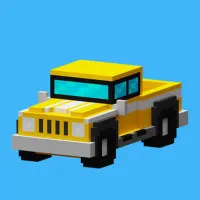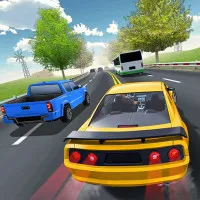














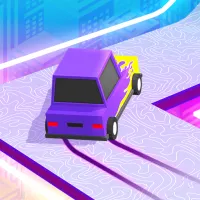





Loop Crash does not lead you to direct racetracks or recognisable bends. It ensnares you in a perpetual cycle, where each iteration is laden with peril.

The Racecourse Transforms Into a Circuit of Stress
The sense of safety is virtually absent due to the continuous intersection of lanes. The racing game prioritises rhythm, timing, and calm under increasing pressure with each lap. During daylight, unobstructed visibility enables players to more accurately evaluate the circumstances. With the onset of night, diminished vision becomes each decision even more stressful. Each successful lap awards points and bonuses, fostering motivation to sustain an extended streak. Nevertheless, the game does not promote impulsive gameplay. Rather, consistency and the capacity to regulate the tempo are the critical determinants for achieving good results.
Essential Racing Mechanics
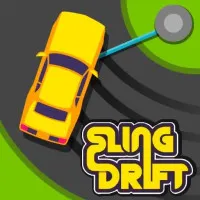
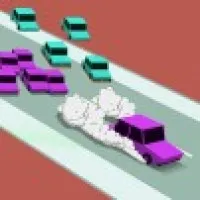
The vehicle autonomously navigates on a circular path, intersecting another circle at perilous junctures. Players solely regulate the pace, not the steering. This simplicity engenders significant profundity. When the car gets close to a crossing, it's important to quickly check the flow of traffic going the other way. Accelerating at the right time makes it easier to get through the narrow space, and stopping quickly prevents frontal crashes. The speed progressively escalates as the volume of vehicles on the road rises. The initially simple laps transform into a challenge of precise forecasting abilities.
Loop Crash employs solely two primary actions: acceleration and deceleration. Instead than memorising elaborate combinations, players should work on their timing and spatial awareness. Unexpected braking can interrupt the vehicle's cadence, and continuing to press the accelerator may result in junction crashes.
- D/Up arrow key: Accelerate, enabling the vehicle to swiftly navigate intersections when a secure gap is present.
- A/Down arrow key: Reduce speed, preserve distance, and prevent crashes under busy traffic conditions.